If your child loves gymnastics, it’s only natural to want to support that passion at home.
Maybe they’ve come back from training excited.
Maybe they’re frustrated after a competition.
Maybe they’ve set their heart on a goal like “I really want my kip” or “I keep wobbling on beam”.
Many parents sit quietly with the same questions:
-
- Should we be doing more gymnastics exercises at home?
- Is home practice actually helpful?
- What gymnastics exercises are safe, and what could backfire?
These questions don’t come from pressure. They come from care.
The reality is that home gymnastics exercises can be valuable when they are chosen carefully, grounded in foundations rather than skills, and aligned with what’s happening in the gym.
What “Safe” Gymnastics Exercises at Home Really Mean
One of the biggest misunderstandings in gymnastics is the difference between skills and foundations.
Gymnastics skills, such as tumbling, bar skills, and beam routines, require qualified coaching, spotting, and specialised equipment.
Gymnastics exercises, when designed well, build the physical foundations that support those skills without trying to replicate them.
Safe home gymnastics exercises focus on:
-
- Strength capacity
- Alignment and body shapes
- Stability and control
- Mobility and activation
- Body awareness
They are not about rushing progress or practising routines outside the gym. They are about supporting the work already being done in training.
How Coaches Think About Home Gymnastics Exercises
Most experienced coaches aren’t against home training.
They are cautious about unguided home training.
Coaches consistently explain that home gymnastics exercises are most effective when they support something specific already being worked on in the gym, rather than adding extra load or confusion.
Home training works best when:
-
- There is a clear purpose
- The exercises address a genuine limiting factor
- The overall volume is reasonable
- The focus is on quality, not repetition
- The coach’s intent is respected
When these pieces are in place, home gymnastics exercises can actually make training feel easier rather than harder.
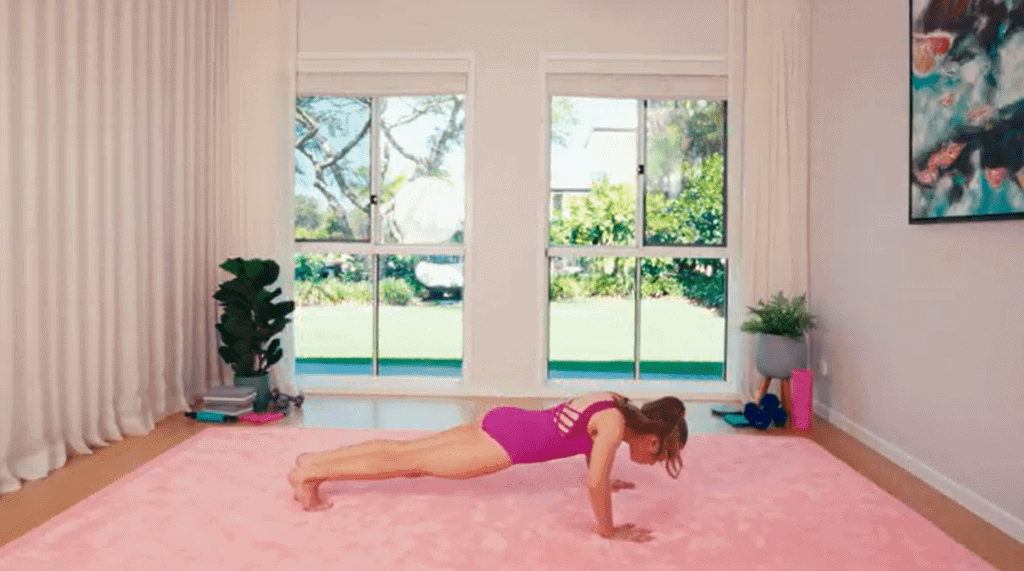
Coach-Approved Gymnastics Exercises That Support Training
Supporting Bar Progress Without Doing Bar Skills
Scenario: A gymnast is highly motivated to get her kip.
Rather than practising swings or kip drills at home, which isn’t safe or effective, a coach might identify that she needs:
-
- Faster feet to the bar
- Stronger mid and lower core
- Better compression strength
Appropriate home gymnastics exercises may include:
-
- Compression holds, seated or supported
- Controlled leg lifts
- Hollow-to-tuck transitions
- Core timing and control exercises
These exercises don’t teach the skill. They build the physical readiness that allows the skill to develop safely in the gym.
Improving Toe Point and Straight Legs
Execution deductions are a common source of frustration for parents.
Soft knees or poor toe point are rarely about effort. They are usually about activation and awareness.
Safe home gymnastics exercises that support execution include:
-
- Theraband ankle point and flex work
- Straight-leg lifts with visual feedback
- Inner-thigh and quad activation
- Slow, deliberate relevés with alignment focus
Clean execution often improves through consistent off-apparatus awareness, not more skill repetition.
Reducing Beam Wobbles Through Stability
If a gymnast wobbles on beam, the instinct is often to practise beam more.
In reality, beam confidence is strongly influenced by:
-
- Ankle stability
- Foot strength
- Balance control
- Nervous system regulation
Safe home gymnastics exercises may include:
-
- Single-leg balance holds
- Ankle stability exercises
- Controlled calf raises
- Foot intrinsic strengthening
These exercises can meaningfully support beam performance without touching a beam at home.
Wall Handstand Work, When It’s Used Correctly
Handstands are often labelled unsafe at home, and in many contexts that caution is justified.
However, wall handstand work can be appropriate when:
-
- It is taught through a clear, structured system
- The focus is on shape, alignment, and shoulder stability
- It is treated as a strength and body awareness exercise, not a skill
- Duration, surface, and cues are carefully controlled
Used this way, wall handstands support shoulder strength, core engagement, and body line awareness without dynamic movement.
Bridge Work as Preparation, Not Performance
Bridge work also needs clear boundaries.
Random kick-overs or pushing into deep ranges at home is not safe. Controlled bridge exercises, taught properly, can support:
-
- Shoulder flexibility
- Hip extension
- Spinal awareness
- Preparation for back-bending skills in the gym
Appropriate home bridge work focuses on control, alignment, and gradual range rather than depth.
Understanding Home Training Load
One aspect parents often don’t consider is total weekly load.
If a child trains 12 hours per week at the gym, adding even 20 minutes of home gymnastics exercises each day can add more than two extra hours of training.
Overuse injuries rarely come from one dramatic moment. They develop gradually when recovery does not match demand.
Sometimes the most supportive thing a parent can do is ensure their child has enough rest between sessions.
Normalising Home Training
Home gymnastics exercises are not:
-
- A requirement
- A measure of commitment
- A shortcut to success
They are an optional support tool.
Some gymnasts benefit from short, targeted home sessions. Others need rest, recovery, or mental space between trainings. Both approaches are valid.
A Note on Online Videos and Social Media Content
It’s completely understandable that parents look online for guidance.
YouTube and Instagram are full of gymnastics exercises promising faster progress or easy fixes. The challenge is that most of this content is created without knowing your child, your gym’s program, or the training load already happening.
Many online videos:
-
- Are not reviewed by qualified gymnastics coaches
- Are not assessed by physiotherapists
- Do not account for age, level, growth, or injury history
- Prioritise what looks impressive over what is appropriate
Coaches often say they can spot a gymnast who has been copying online drills very quickly. The shapes don’t match what is being taught in the gym, and the body is not ready for what is being attempted.
This does not mean all online content is bad. It does mean parents need to be cautious about using unvetted videos as a home training guide.
What Still Doesn’t Belong at Home
Even within a guided system, some boundaries are essential.
Home training should not include:
-
- Unsupervised skill progressions
- Tumbling or dynamic acrobatics
- Bar swinging or release elements
- Improvised equipment
- High-volume conditioning without load awareness
Safety is not about removing challenge. It is about controlling it.
Common Questions Parents Ask About Gymnastics Exercises at Home
Should we discuss home gymnastics exercises with our child’s coach?
Yes. Alignment helps ensure exercises support training rather than overload it.
How often should gymnastics exercises be done at home?
Usually two to three short sessions per week, depending on age, level, and training load.
Are wall handstands and bridge work always safe at home?
They can be safe when taught and progressed through a structured system with clear boundaries and purpose.
Can home gymnastics exercises improve competition performance?
Yes. They are particularly effective for execution, stability, and confidence when they support what is already being taught in the gym.
Should my child practise skills at home if she’s motivated?
Skills belong in the gym. Motivation is best channelled into safe foundation work at home.
How Parents Can Support Gymnastics Exercises at Home
Foundations First, Always
The most effective gymnastics exercises at home are not flashy.
They are controlled.
They are intentional.
They are grounded in foundations.
When home training is guided, coach-aligned, and focused on preparation rather than performance, it becomes a powerful way to support your gymnast without rushing her or putting her at risk.
Support for Gymnastics Parents – All in One Place
If this article helped you understand your child’s gymnastics journey a little more clearly, Gymnastics Online is being created for parents just like you – those who want to support their gymnast with confidence, perspective, and care.
We’re building a trusted space with expert guidance, practical resources, and a parent community – all designed to help you navigate each stage without confusion or overwhelm.
You’ll also receive emails with guidance, updates, and community support
Related reading
- What home gymnastics equipment is worth buying
- Why gymnastics skills sometimes disappear
- Why beam is the hardest apparatus to master
Ready to feel more confident in the gym — and in the car park?
Be Part of the Inner Circle →
Kym Volp
Founder, Gymnastics OnlineFounder of Gymnastics Online. Former gymnast, qualified intermediate judge, and gym mum. Kym created GO to bridge the gap between clubs and families — empowering parents and gymnasts with tools to build strength, confidence, and a love of the sport.