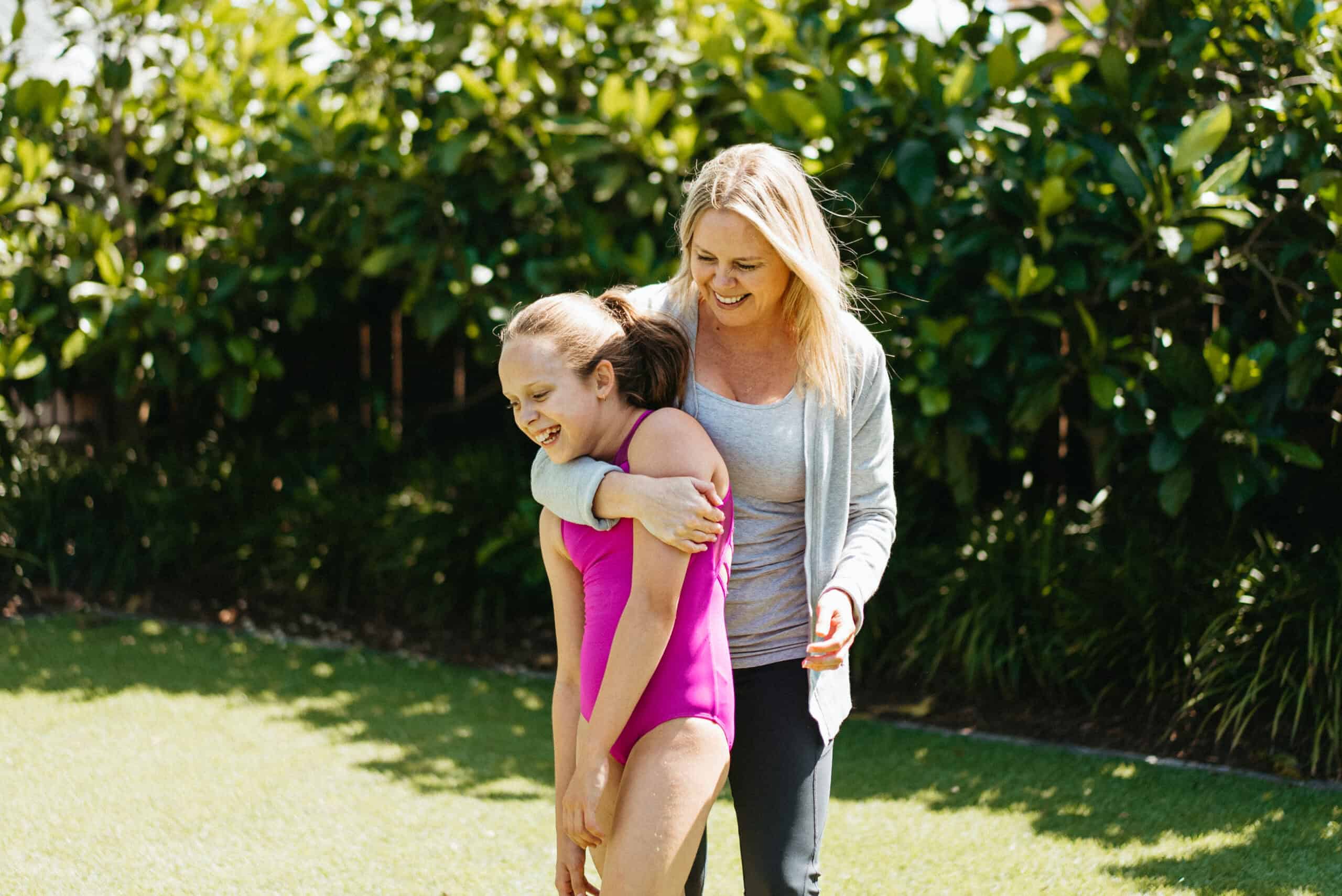
If you are new to competitions, the thing that surprises most parents is how little of the day you can actually follow.
She disappears into a warm-up somewhere you cannot see. Thirty girls in matching leotards move between apparatus in an order nobody explains. A number appears on a screen and you have no idea whether it is good.
Around you, other parents seem to know exactly what is happening. Most of them are guessing too.
You are not missing something obvious. Gymnastics is one of the harder sports to spectate, and almost nobody sits parents down and explains the day before they turn up to it.
In the US it is a gymnastics meet. In Australia and most of the rest of the world it is a competition. Either way, nobody explains it.
What follows is the shape of the day, what young athletes say they actually want from the people watching, and what to do with the twenty minutes afterwards.
How a gymnastics meet is built
Individual clubs have their own names for the parts of the day, so your program may not use quite the same words as the one below.
The shape is consistent almost everywhere.
Sessions
Gymnasts are grouped into sessions by level, and often by age within that level. Your daughter’s session has a published start time, and everything else on the timetable belongs to someone else’s session.
This is worth checking before you leave the house. Parents routinely arrive for the start of the day rather than the start of her session, and then sit through three hours of a level they have never heard of.
Check-in and the general warm-up
Gymnasts arrive well ahead of spectators, often an hour or more before the session begins. She checks in, collects a competitor number, and goes to the floor with her coach.
Then comes a general warm-up: stretching first, then some work across the apparatus. In some venues this happens in front of you. In others it happens in a separate warm-up hall you cannot see into, which is why the floor can look empty for a long stretch before anything starts.
The march on, or the march in
Gymnasts are presented to the judges and the crowd, usually club by club. Australian programs tend to call this the march on and US programs the march in. It is the same thing.
This is the moment most spectators are aiming for, and it is a reasonable arrival time if you have grandparents coming who do not need the full four hours.
Rotations and Olympic order
Women’s artistic gymnastics has four apparatus, competed in a fixed sequence: vault, uneven bars, beam, floor. That sequence is called Olympic order.
Her group will not necessarily start on vault. Groups are spread across the apparatus so that the competition runs in parallel, and each group then moves through the rest of the order and wraps back around. A group starting on beam competes beam, then floor, then vault, then bars.
Nothing about which apparatus she starts on says anything about her ranking, her ability, or what her coach thinks of her.
Byes
Four apparatus and five groups do not divide evenly, so some groups sit out a rotation. That is a bye.
From the gallery it looks like an unexplained gap where your daughter does nothing for twenty minutes. It is on the schedule and it happens to everyone.
The warm-up before each apparatus
In most junior formats, a group gets a short, timed warm-up on an apparatus immediately before competing it. It is brief, and it is often the only contact she has with that particular bar or beam before it counts.
This is the part of the day most likely to look chaotic and most likely to be strictly controlled. Coaches are managing a clock.
The routine itself
She waits for a signal from the judge, raises her arm to salute, competes, and salutes again at the end. The salute is not decoration. It is how she tells the panel she is ready, and how she tells them she has finished.
If she is standing still facing a table of judges and nothing is happening, she is waiting for permission, not freezing.
Scores and awards
Some competitions post scores as they go. Some hold everything until the end. Some junior levels do not publish scores at all, deliberately, because the emphasis at that stage is participation.
Awards run at the end of the session, usually by apparatus and then all-around, divided into age groups within the level. Plan for three to four hours in total, including presentations.
Parent Translation
Almost everything that looks like chaos on the floor is running to a schedule somebody else is holding. Nothing in the first hour is a performance, and none of the gaps mean anything has gone wrong.
The all-around, and why the placings can look strange
Her four apparatus scores add together to make an all-around score. Most competitions award medals for individual apparatus and for the all-around separately.
Age divisions are where it gets confusing. Girls competing the same level are usually split into age groups for awards, so two gymnasts with identical scores can go home with different colored medals, or one with a medal and one without.
Falls are the other thing that distorts a result. Under most codes a fall carries a set deduction, applied whatever else happened in the routine, which is why a difficult routine with one fall can finish below a simpler one performed cleanly.
If you want the mechanics of how the number itself is built, we have written about that separately in gymnastics scoring explained.
The morning
Most of what helps on a competition morning is unremarkable, and that is rather the point.
- Do the bag the night before. Competition mornings are not the time to discover a missing grip or a leotard still in the wash.
- Allow far too much time for hair. Every gymnastics parent underestimates this exactly once.
- Keep breakfast familiar. Competition day is a poor day to introduce a new food. Plenty of gymnasts are too nervous to eat much, and that is common rather than a warning sign.
- Arrive with margin. Rushing is contagious, and she will catch yours.
- Let her set the tone in the car. Some gymnasts want music and chat. Some want silence. Neither one predicts how the day will go.
The less obvious one is how much you talk about the competition itself in the days before it.
Coach Insight Moment
I was adding pressure without saying anything about pressure
It took me longer than I would like to admit to work this out with my own daughter. I was not pushing her. I was not setting targets or talking about medals. I was just raising the competition, gently and often, because I wanted her to know I was interested and I wanted her to feel prepared.
What I eventually understood was that every time I brought it up, I handed her something extra to carry. She had to have an answer ready. She had to manage how I felt about her answer. None of that was work she needed on top of the routines.
So I stopped raising it and let her lead. If she wanted to set goals, we set them together. If she did not mention it for three days, I did not mention it either. It was one of the best changes I ever made, and it cost me nothing except the urge to be helpful.
What young athletes say they want from the people watching
This turns out to be one of the few questions in youth sport where somebody thought to ask the children directly.
In a study published in Research Quarterly for Exercise and Sport, researchers interviewed 57 children aged 7 to 14, away from their parents, and asked two questions: how do parents usually behave at your events, and how would you like them to behave. Three roles came out of the answers, which the researchers named the supportive parent, the demanding coach, and the crazed fan.
The behavior children preferred most strongly was the one you would least expect to top a list. The researchers called it attentive silence, and described it as staying seated, keeping your own emotions in check, and holding a positive attitude while genuinely paying attention.
Cheering was wanted too, with conditions. Several children said that being singled out by name was distracting or embarrassing, because it confirmed that someone was watching specifically for mistakes. A number of them preferred parents to cheer for the whole group.
The finding most of us will not enjoy
The researchers identified a category they called critical encouragement. It means saying something technically positive in a tone that gives away your frustration with how it has gone so far.
The examples the children gave were “Come on, you can do it” and “You can do better.”
Those did not land in the supportive parent column. Children filed them with instruction and advice, under the demanding coach, and described them as annoying and hurtful.
That is a hard sentence to read if you have ever said either of those things, and most of us have. It is worth understanding why they land that way. From the floor, a phrase about what she is capable of arrives as evidence that you have been evaluating what she has done so far.
A separate study of 42 junior tennis players, mean age 13, found the same shape from a different angle. Those players did not want technical or tactical advice from parents at competitions. What they did want was comment on effort and attitude, practical help, respect for the etiquette of the sport, and, notably, nonverbal behavior that matched the supportive words.
That last one transfers into gymnastics more sharply than into almost any other sport. She can see the viewing gallery from the beam.
Parent Translation
Your face is part of the message. She will read it from the floor, and she will read it before she reads anything you say afterwards.
On knowing she is watching you watch her
There is research measuring pre-competition anxiety in young athletes against whether their parents were present. Across 341 young competitors, having both parents there was associated with higher anxiety for most groups.
Before anyone books a coffee for the duration, the same study found that having neither parent present was not associated with less anxiety. Staying away does not solve it.
What it tells you is smaller and more useful. She knows you are there, that awareness is a real part of her experience of the day, and it is not a sign that anything has gone wrong between you.
Why the running order above is the practical part
Nearly everything in that demanding coach column comes from love and from not knowing what is happening on the floor.
A parent who does not know what a timed warm-up is will call out during one. A parent who does not know what a bye is will assume something has gone wrong and start signaling. A parent who has read a running order sits still, because there is nothing to fix.
Five minutes of understanding the schedule removes most of the impulse to intervene, which is a far easier path than trying to hold yourself back on willpower for four hours.
The twenty minutes afterwards
Her competition does not end when she walks off the floor. It carries on in her head for a while, and the car is usually where it is still running.
The tennis players in that second study were clear about feedback: they wanted comment on effort and attitude, not on technique. Two American coaches, Bruce Brown and Rob Miller, spent three decades asking college athletes what their parents said that helped. Their answer became one of the most repeated lines in youth sport: “I love to watch you play.”
That was an informal survey rather than a study, and it is worth knowing which of the two you are holding. It has lasted because thousands of athletes recognized themselves in it, not because it was measured.
In practice, the openers that keep the door open are small and do not try to achieve anything.
- “I loved watching you today.” It says you were present and it asks nothing of her.
- “I love you.” Separates her from the result entirely, which is the thing she is least sure about in that moment.
- Nothing at all. The hardest one. Driving, and letting the silence be company rather than a question.
The conversation about the routine can wait. It usually happens later that night, or at training two days afterwards, and it goes considerably better when she is the one who starts it.
If she cries in the car, that is not a sign the day was a disaster. We have written about what tears in and around the gym usually mean in is it normal for her to cry at training.
What goes in the bag
- Competition leotard, plus a spare training leotard. Things tear, and things get left at home.
- Grips and wristbands if she uses them, along with spare hair elastics and tape. Grips fail at the worst possible moment and a spare set of elastics has saved more warm-ups than anything else in the bag.
- Hair supplies beyond what you think you need. Brush, gel or spray, clips, spare ties.
- Water, and food she already likes. Long sessions with a bye rotation leave real gaps, and those gaps are not the moment for an experiment.
- Warm layers and slides. Venues are cold, waits are long, and she will be in a leotard for hours.
- Anything her coach has specifically asked for. Club warm-up gear, competitor number, medical items. The coach’s list beats this one.
- For you: a cushion. Four hours on metal seating is its own event.
FAQs about gymnastics meets
How long will we actually be there?
Three to four hours is typical for one session of a meet, including awards, and your daughter will be there an hour or more before that. If family are coming to watch, the march in or march on is a sensible arrival time.
Can I talk to her coach during the competition?
Generally no, and not because anyone is being unfriendly. The coach is managing warm-up timings, spotting, and several gymnasts at once, and their attention belongs on the floor. Most clubs have a preferred way and time to raise things, which we cover in how to talk to your gymnast’s coach.
Why was her score lower than the same routine at training?
Competition scores move for a long list of reasons that have nothing to do with how hard she tried, including differences in judging panels and the apparatus itself. Our piece on gymnastics scoring works through how the number is built.
Can I take photos or video?
Policies differ by venue and by governing body, and many venues restrict flash because it is a genuine safety issue for a gymnast mid-skill. Check the competition information rather than the parent next to you.
She is too nervous to eat. Should I worry?
Plenty of gymnasts eat very little on a competition morning and it is a common part of the day. If nerves are weighing on her more broadly, or showing up well before competitions and lasting well after them, that is a conversation for her coach and, if it continues, a professional.
What do I say if she falls?
Less than you want to. She knows she fell, she knows the score, and she has already had the conversation with her coach. What she has not had yet is one person treating her the same as before she fell.
This is general parent education, not clinical advice. Competition nerves are a normal part of the sport. If your gymnast is going through something that feels bigger than the sport, persistent anxiety affecting school, eating concerns, anything safety related, please speak to a registered health professional alongside whatever else you are doing.
Across a season, your job in this sport is large and active. You are the one learning the terminology, managing the load at home, noticing what she is not saying, and getting her to the gym four evenings a week.
For three or four hours on a competition day, almost none of that applies. The floor belongs to her and her coach, and when researchers asked children what they wanted from the adults in the seats, they did not ask for more input. They asked for someone paying attention, sitting down, and still being the same person in the car afterwards.
That is a smaller job than it feels like from the viewing gallery, and a much harder one. It is also the part she will remember.
Gymnastics Online is being built to support parents through the realities of the sport, with clear guidance, expert insight, and a community that understands what this journey really looks like.
Ready to feel more confident in the gym — and in the car park?
Be Part of the Inner Circle